UK grid reform is still under way. For years, grid connections ran on first come, first served: apply early and you kept your place in the queue, ready or not. That is ending.
The first stage is done. Projects in the queue have been told whether they passed a readiness test. Now it is time for NESO, the National Energy System Operator, to issue offers to the projects that did. In the jargon, that offer is Gate 2: a firm connection date, a point on the grid, the works and the cost.
In this issue I unpack what that means. Not just the commitment you make when you sign today, but the commitments that run across the whole development timeline, from planning to construction.
There has been a lot of noise about it: offers arriving late, dates slipping, connections pushed back by years. So I went back to what Ofgem, NESO and the network operators have published. The record tells a narrower story.
In February, Ofgem said that 210 of the 340 "protected" transmission projects with 2026 and 2027 dates, 62%, would have their date or connection point changed. About 135 of those were at least partly down to the network, and 75 to the developer. Ofgem told NESO and the transmission owners to offer "the most ambitious date possible". In National Grid Electricity Distribution's (NGED) customer Q&A on 14 October, a developer said a protected project with a signed 2027 date had been told it might now wait until 2033. NGED replied that "a small number" of protected projects are in that position, and that it does not expect to see it again in Phase 2.
So multi-year slips are real, but on the record they are a small number of cases. For most developers the harder part is quieter: what the offer commits you to, and for how long.
What Gate 2 is, and why it exists
Connections reform reorders the queue on two tests. Is the project ready, judged on evidence such as land rights and the planning route? And does it fit the government's Clean Power 2030 plan?
A project that passes gets a Gate 2 offer. A project that does not gets Gate 1. Its old date becomes indicative only, any cash security is refunded, and it can reapply in a later window.
Gate 2 runs in two phases, set by the Clean Power 2030 plan: Phase 1 for connections needed from 2026 to 2030, Phase 2 for 2031 to 2035. The phase is not a promised date, and NESO says the date in your offer may fall outside it. In each phase NESO issues transmission offers first, then the distribution network operators (DNOs) issue offers to smaller projects.
Where things stand
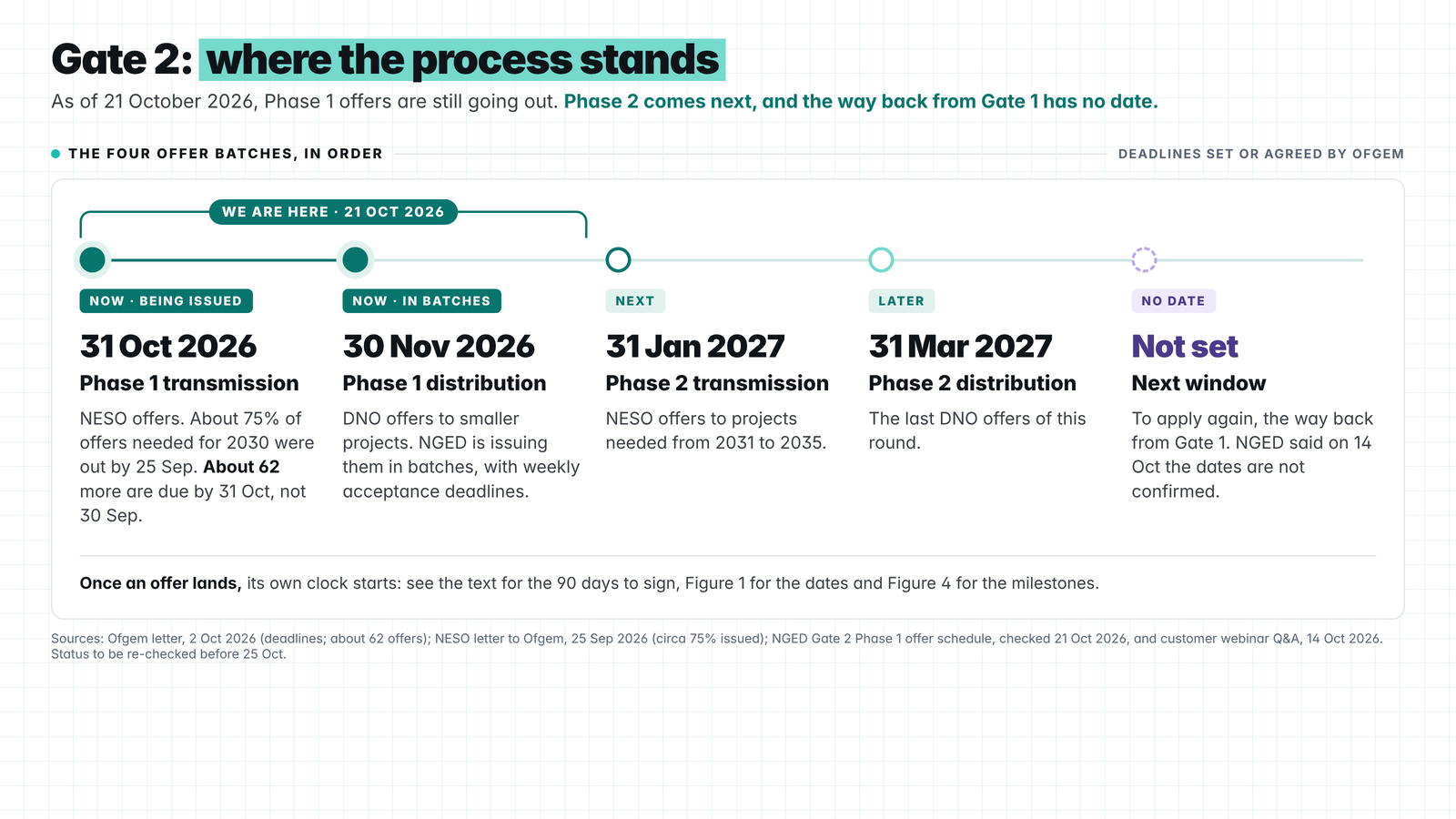
There are four deadlines, all set or agreed by Ofgem:
- 31 October 2026: the last Phase 1 transmission offers from NESO, about 62 of them. The deadline moved from 30 September, mainly to give National Grid Electricity Transmission time on complex engineering. As of 24 October I have found no notice that they are all out.
- 30 November 2026: Phase 1 distribution offers from the DNOs. NGED issues these in batches. Its next acceptance deadlines are 26 October and 2, 9, 16 and 23 November.
- 31 January 2027: Phase 2 transmission offers from NESO.
- 31 March 2027: Phase 2 distribution offers from the DNOs.
The next application window, the way back from Gate 1, still has no date. NGED said on 14 October it had not been confirmed.
What it means commercially
Every offer you sign brings years of dates the business has to hit. Two things set them: the clock to sign, and the milestones after it.
The clock. For a NESO transmission offer you have 90 days to sign. Queries must be raised within four weeks, and the 90 days keep running meanwhile. Little can change: only milestones M5 to M8, and the date only if your project was moved earlier. Security is due within 30 days of NESO countersigning. It can be anything from zero to several million pounds, and it is recalculated every six months. DNOs set their own timelines. NGED's acceptance windows run 38 to 52 days from issue, by my arithmetic.
The milestones. The signed agreement carries eight milestones, worked back from your connection date (Figure 3):
- M1, consents started: a full planning application submitted and validated. Due at the earlier of two years from the offer (three for Section 36 or DCO, five offshore) or the date worked back from connection.
- M2, consents secured: planning permission for the contracted site, technology and capacity.
- M3, land secured: you own or lease the land, or hold a qualifying option, and keep it.
- M4: not used for transmission connections.
- M5, contestable design: only if you self-build part of the connection.
- M6, construction plan agreed with the transmission owner.
- M7, project commitment: a main plant contract, a minuted FID, a subsidy such as a CfD, or capital contributions paid. It falls 6 to 15 months before your contracted completion date.
- M8, construction started.
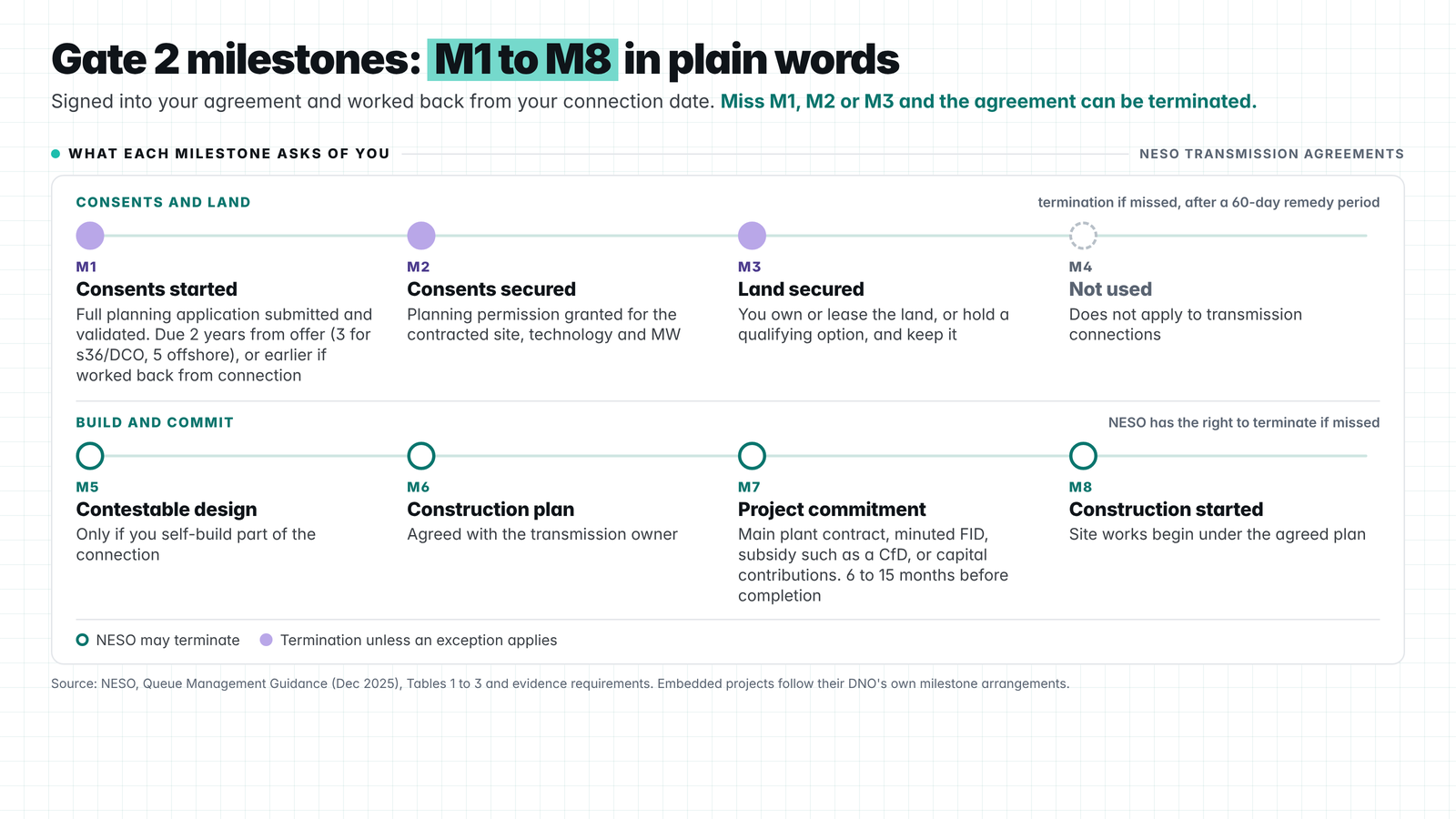
Miss M1, M2 or M3 and NESO gives you 60 days to put it right, then terminates the agreement unless an exception applies. For M5 to M8, NESO has the right to terminate. Distribution offers follow each DNO's own arrangements.
The risks either way
If you sign, the offer's dates become your commitments.
- Cash. Security is due 30 days after countersignature and can be reset upwards every six months. Who funds it, and what happens if it rises?
- Consent and land. M1 to M3 are the termination milestones. M1 already requires a full, validated application, so the real test is timing. Does the consent programme hit the M1 and M2 dates, and will the land rights hold for M3?
- Revenue. M7 ties the grid contract to your route to market. For a CfD, the connection date is checked against your target commissioning date. Does the date fit the revenue plan? And what will evidence M7, and by when: a CfD, an FID or a main plant contract?
- A date you cannot move. After the four-week window, you are accepting terms you can no longer correct.
If you decline, or let it lapse, you go to Gate 1. Your date becomes indicative, your cash security comes back, and the next window has no date. You can also lose your route to a CfD.
Gate 2 and the CfD. A Gate 2 offer doesn't commit you to a CfD round, but it decides which rounds you can realistically enter, because your CfD target commissioning date has to fall on or after your connection date. AR8, now past its application window with sealed bids expected in early December, let projects in on their Gate 2 status and old connection date, or on a Gate 1 reservation of connection point and capacity. From AR9 the CfD will need the signed agreement itself. So a project left at Gate 1 without that reservation is shut out of future rounds until it gets back to Gate 2.
If the network later pushes your date back, the Low Carbon Contracts Company has said that can count as grid delay, so you can ask to extend your CfD milestone, commissioning window and longstop dates. That relief isn't automatic, and a delay you caused yourself gets none.
Either way, price both answers side by side, on one page the board can sign.
After the deadline: what you keep
For many teams the Phase 1 work is done: offers read, dates checked, security argued over, papers taken to the board. Much of it sits in inboxes, decks and spreadsheets only one person understands.
The work is not over. Phase 2 offers are due by 31 January 2027, and many developers will have projects in both phases. Each signed offer then sets M1 to M8 dates that run for years, across consent, land, procurement, revenue and finance.
So the question shifts from "how do we get through this deadline?" to "how do we keep what we have learned, and follow it through?"
In my view the basics go a long way. Keep one record per offer, with its dates, security, milestones and evidence. Give each decision a named owner: the query, the decision to sign, the security, the M7 evidence. Check every update against the project plan and the CfD timeline, so a slipping date is caught in time. A well-run system, with AI doing some of the reading and checking, makes that easier to keep up. The decisions stay with people.
Then Phase 2 starts from what Phase 1 taught you, and M7 doesn't arrive as a surprise years from now.
I wrote this to understand Gate 2 properly, beyond the noise. What struck me most is how much of the real work starts after the offer is signed: keeping consent, land and design in step with the milestones, and spotting slippage before it costs you. If you are working through your offers now, I would like to hear how you are approaching it. Send me a message on LinkedIn.
How are you tracking your Gate 2 commitments today?
Yorik
Sources
- Ofgem, agreement to a further alternative timetable for Gate 2 Phase 1 offers (G2tWQ), 2 Oct 2026: 31 Oct deadline, about 62 offers, the NGET reasons; Phase 1 distribution by 30 Nov 2026, Phase 2 transmission by 31 Jan 2027, Phase 2 distribution by 31 Mar 2027. https://www.ofgem.gov.uk/sites/default/files/2026-10/Ofgem-agreement-for-revision-to-G2TWQ-timetable.pdf
- Ofgem, response on the Protected Projects relief request, Feb 2026: 210 of 340, 135 network-driven, 75 developer-driven, "the most ambitious date possible". https://www.ofgem.gov.uk/sites/default/files/2026-02/Ofgem-Response-on-Protected-Projects-Relief-Request.pdf (also reported by edie, 12 Feb 2026, https://www.edie.net/hundreds-of-uk-power-projects-face-grid-connection-delays-despite-reforms/, and Regen, https://www.regen.co.uk/insights/where-are-we-on-connections-reform)
- NGED, Connections Reform customer webinar and Q&A, 14 Oct 2026: the 2027 to 2033 question and "a small number" answer; next window not confirmed; the Phase 1 and Phase 2 distribution completion dates. https://connections.nationalgrid.co.uk/asset/0/document/271091/2026-10-14-final-customer-connections-reform-webinar.pdf
- NGED, Gate 2 Phase 1 offer schedule (checked 21 and 24 Oct 2026): batch acceptance deadlines. https://connections.nationalgrid.co.uk/connections-reform/gate-2-phase-1-offer-schedule
- NESO, "Connections Reform What Next: Post Notifications Customer Handbook", Dec 2025: Phase 1 (2026 to 2030) and Phase 2 (2031 to 2035) as the CP30 phase allocation, not a guaranteed date; Gate 1 and Gate 2, 90 days to sign, security from zero to several million pounds, reset every six months, Gate 1 refund. https://www.neso.energy/document/373546/download
- NESO, "Connections Reform: Transmission Offers" webinar, 24 Feb 2026: four-week query and change window; only M5 to M8 changeable; date only if advanced. https://www.neso.energy/document/377636/download
- NESO, Securities webinar, 25 Mar 2026: 30 days start at NESO countersignature. https://www.neso.energy/document/379571/download
- NESO, Queue Management Guidance, Dec 2025: M1 to M8, evidence (including full, not outline, applications for M1), M1 and M7 timing, 60-day remedy and termination. https://www.neso.energy/document/375081/download
- NESO (EMR Delivery Body), CfD AR8 Application Submission Guidance, v2.2, Jul 2026: Gate 2 or Gate 1 CPCR eligibility; connection date checked against target commissioning date. https://www.neso.energy/document/383326/download
- NESO, letter to Ofgem, 25 Sep 2026: background on the Phase 1 extension; circa 75% of the offers needed for 2030 issued by then (Figure 1). https://www.neso.energy/document/387846/download
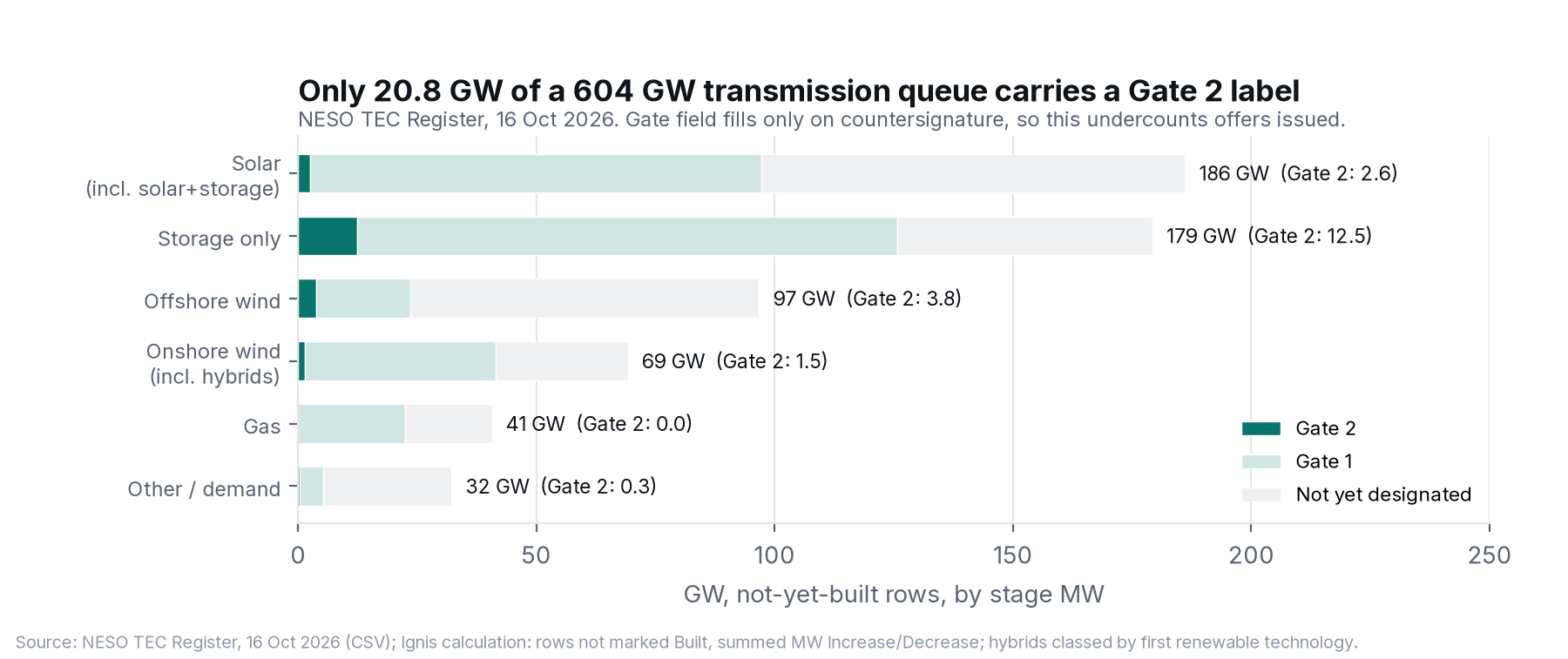
- Ignis Market Monitor, October 2026: Gate 2 section and TEC Register chart (Figure 2 here). https://www.ignisleadership.com/reports/market-monitor-2026-10
Commercial commentary, not legal, regulatory or investment advice. Terms differ by project and network, so always read your own offer. "By my arithmetic" marks my own calculation. Sources checked 21 October 2026.

About the author
Yorik Tisseau (MBA) is the founder of Ignis Leadership. He has 17 years of engineering, operational and commercial experience across energy and infrastructure, including bp, RWE and Bouygues, from project engineer to Bid Director.
Today, he helps growth-stage developers and IPPs design governed human-AI workflows around the commercial decisions and deadlines that matter.