
The short version: The UK backs COP31's pledge to raise electricity to 35% of final energy use by 2035.1 It is voluntary, and the real limit is connections, not ambition. My read: the mistake was treating generation, wires and demand as three separate plans. Headroom first. Bridges second. New wires third. All three, planned together. The fastest megawatts now come from optimising the grid we have, at transmission and distribution level, and most of that is commercial and legal decisions rather than steel. Next comes a clean bridge for big new demand: on-site power, flexible compute and hourly-matched supply. Then the £100bn build.
The goal, and the real limit
On 12 November the UK said it backs Türkiye's "35 by 35" pledge: raising electricity's share of final energy use from less than a quarter today to 35% by 2035.1 It published a clean electrification roadmap the same day, which expects UK electricity demand to more than double by 2050.4 The COP31 Presidency calls this the "age of electricity".2
The pledge is voluntary, and it does not say how the extra electricity should be generated.3 And a demand target is only as good as the connection behind it. You cannot electrify a factory or a data centre that is waiting years for a plug.
I spent two and a half years on RWE's UK Round 4 projects, on prospecting and levelised cost optimisation, and did early ScotWind prospecting in 2019. So I come at this from the generation side. Michael Shanks said it bluntly last week: "The mistake was to invest hugely in renewables without thinking about the grid."5 I would put it slightly differently. The renewables were not the mistake. Planning them apart from the wires and the demand was.
Find the headroom first
The queue may be smaller than it looks. After reform, Britain's generation and storage pipeline fell from more than 700 GW to 283 GW, with 99 GW of transmission demand counted separately.6 By 1 October NESO said more than 75% of the offers needed for 2030 had been issued. NESO itself says "an offer is not a project". My read: much of the old queue was paper, and the clean-up is working. Poland, Norway and Denmark are cleaning up their queues too, in different ways.
More capacity from the same wires. National Grid is extending dynamic line rating, which sets line limits from real conditions rather than fixed assumptions, to more than 900 km of lines, adding about 8% average capacity and saving up to £50m over five years. Reconductoring and power-flow controllers have added more than 16 GW of transfer capacity in the current price control.7
Connections that accept limits. A flexible or non-firm connection lets a project connect sooner in return for being curtailed when the network is tight. Ofgem is working on alternative connection agreements for large demand, voluntary flexibility services and possible backstop curtailment.8 The Netherlands has made flexible grid contracts the default for large batteries.9 Denmark cuts the capacity tariff by two thirds for limited access, and asks customers to release capacity they do not use.10
Smarter curtailment. A connection that is curtailed for a few hours in a tight year is worth far more than a firm connection that arrives five years late.
Distribution, not just transmission. At the end of June 2025, 29 GW of demand was waiting on distribution networks, on top of 96 GW at transmission.11 The same flexible terms belong there too.
Almost all of this is commercial or legal decisions: contract terms, tariffs, queue rules. That is why it is fast. The roadmap's own target of 51 to 66 GW of clean flexibility by 2030, two to three times today, points the same way.4 Tier two and three suppliers keep telling me they need pipeline clarity. A clean queue gives them that.
Demand is knocking
Europe has started rationing the plug for new demand.
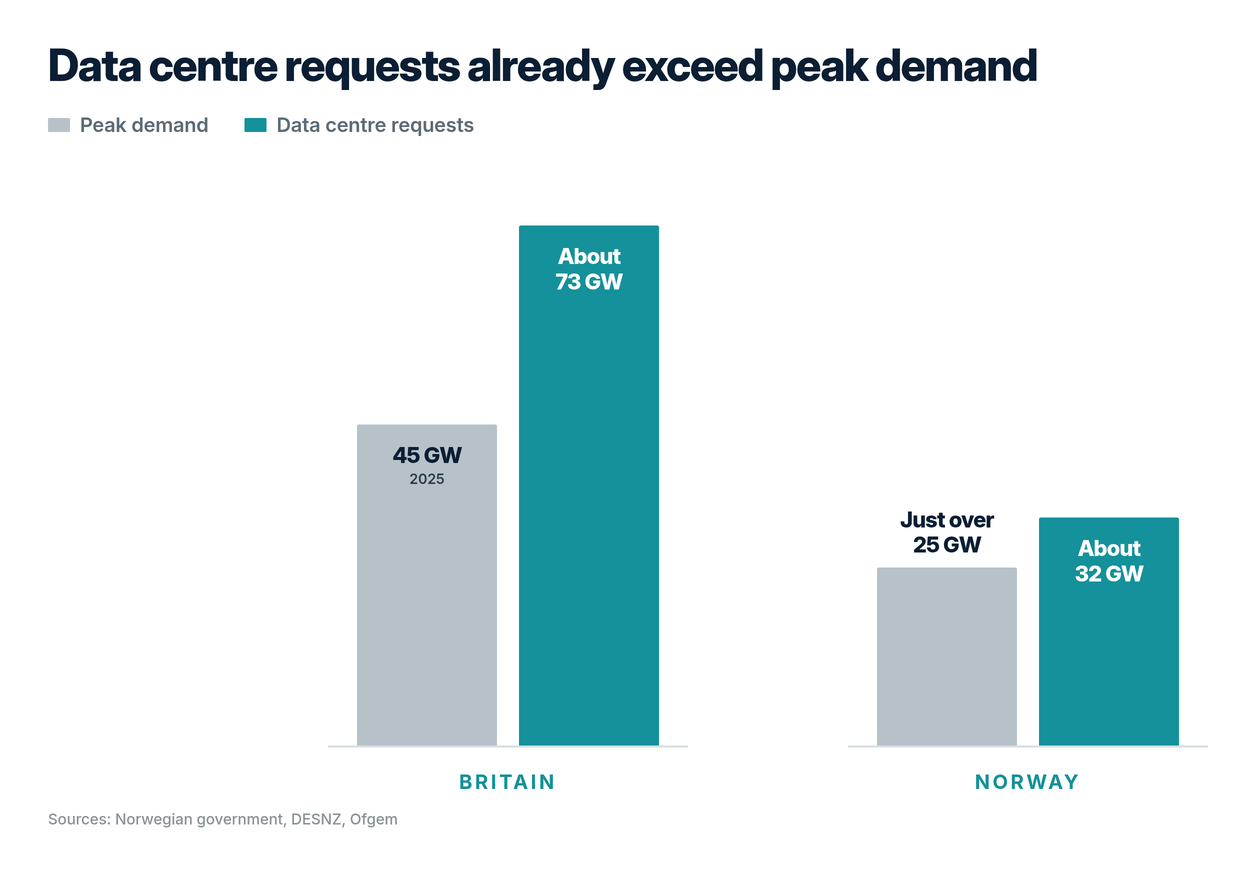
- Norway halted new grid reservations for data centres on 9 November, until no later than 1 August 2027. Connected, reserved, queued and newly requested data centre load comes to about 32 GW, against a national peak of just over 25 GW.12
- Denmark now ranks connection requests, and data centres sit last unless they serve a critical function. A 30 MW Amager project was told 7 to 10 years.10
- Poland did not pause. A new fee and advance payment cut data centre requests at PSE from 150 to 200 GW to about 11 GW.13
- Great Britain's transmission queue has been closed to new applications since mid-2025. Ofgem puts data centres at about 73 GW across about 315 projects, against a 2025 national peak of 45 GW.14 Microsoft walked away from one site because grid power could not come until 2030.15
- Ireland makes new data centres bring dispatchable generation or storage to match their maximum import, and meet at least 80% of annual demand from additional Irish renewables.16
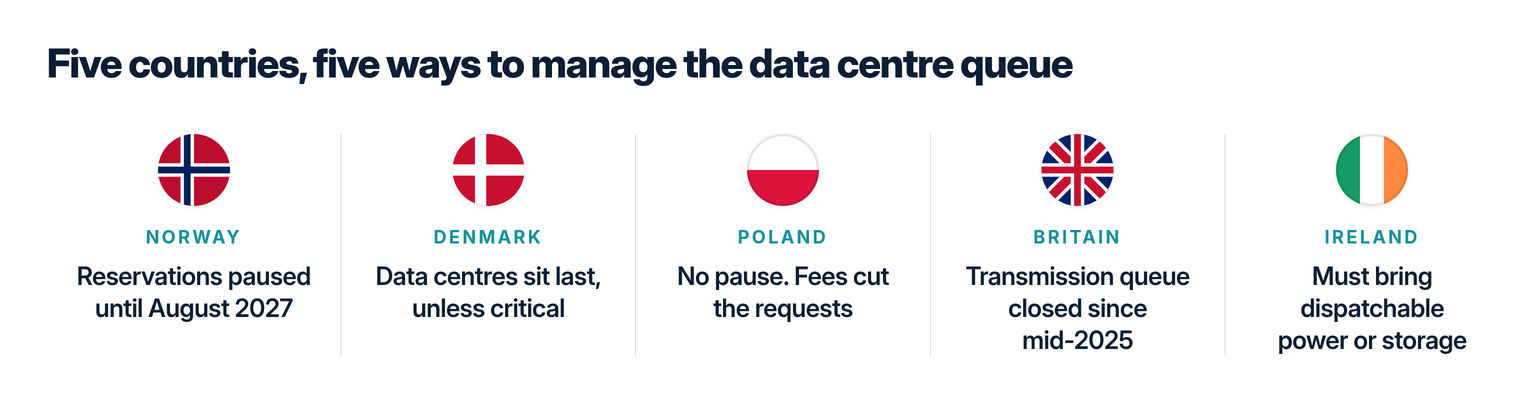
The pattern: from first come, first served to "which load serves the system?", with flexible access as the faster route.
The clean bridge
If the grid cannot come in time, bring some of the system to the site. Behind the meter, on-site generation or storage serves the load directly, over a private wire, rather than waiting for a new grid connection.
Fuse is one company pointing to that model. Its own case for microgrids: they "can also scale electricity provision in developed countries where the old monopoly grid is just too slow."17
In plain English, here is how that can work in Great Britain.18
- One site, one business customer. Generation, batteries and a data centre behind one fence, wired privately, can typically run under existing class exemptions without a new licence.
- Run close to an island. Legally simple, technically hard: the site must hold its own frequency and cover the data centre's uptime, usually with spare gas engines and batteries.
- Connect later. The site joins the same gated queue, but can ask for a smaller, flexible connection because it has its own supply.
The limits are real. Homes bring tight caps, exporting at scale brings back licences and the queue, and charging rules for co-located sites still await an Ofgem decision. Gas may be needed in places. The UK is the exception: it is pushing flexibility, headroom and clean supply first. In the US the picture is different. BloombergNEF has tracked 181 GW of announced gas-fired generation proposed alongside data centres, more than 90% of it in the US. BNEF says the announced pipeline should be viewed as an indication of potential scale, rather than a forecast of what will ultimately be built.19
Flex on both sides
On demand, a London trial by National Grid with Emerald AI and partners cut a GPU cluster's power by up to 40% and held reductions for up to 10 hours. National Grid says this could free more than 2 GW across UK data centres.20 Google now has 1 GW of data centre demand response in utility contracts, which it calls "a key resource for new data centers to connect more rapidly".21
On supply, a Newcastle data centre working with Good Energy reaches a 95.4% hourly matching score, against a market average of about 43%.22 A private wire from an energy from waste plant to a data centre at Avonmouth is planned for as early as 2027.23 My read: a power purchase agreement is a real bridge only if it is physical, hourly, or comes with flex. A virtual deal does not, by itself, solve the physical connection constraint.
Then build
None of this replaces the build. The minister puts the grid upgrade bill at around £100bn.5 But building is only half the answer. Optimisation, flexibility and efficiency are underestimated, and they arrive years earlier.
That is why I am glad the government wants to "pause before AR9".24 The pause is about getting the sequence right, not about delaying investment. The work keeps moving. Use the pause to plan headroom, bridges and new wires together. The goal is the right balance of security, affordability and sustainability, not just speed.
If you are working through the same question, I am happy to talk it through.
If you had to connect 1 GW of new demand in Britain by 2029, where would you find it first: headroom on today's grid, a site that brings its own power, or demand that flexes?
Yorik
Also this week
Battery queue fee: still waiting. Ofgem's decision on CMP470, the commitment fee for oversubscribed technologies such as batteries, was due on 12 November. On 14 November its page still said "awaiting decision".25 Anyone holding a battery queue position should watch it this week.
Hoekstra goes grey. EU Climate Commissioner Wopke Hoekstra hinted that the EU may drop "clean" from its 35 by 35 push to sign up more countries. Charging a car on grey electricity, he said, is "still much better" than driving on fossil fuels.26 My read: he is right that electrification wastes less energy even on today's grid. The risk is a pledge with no plan for the wires behind it.