
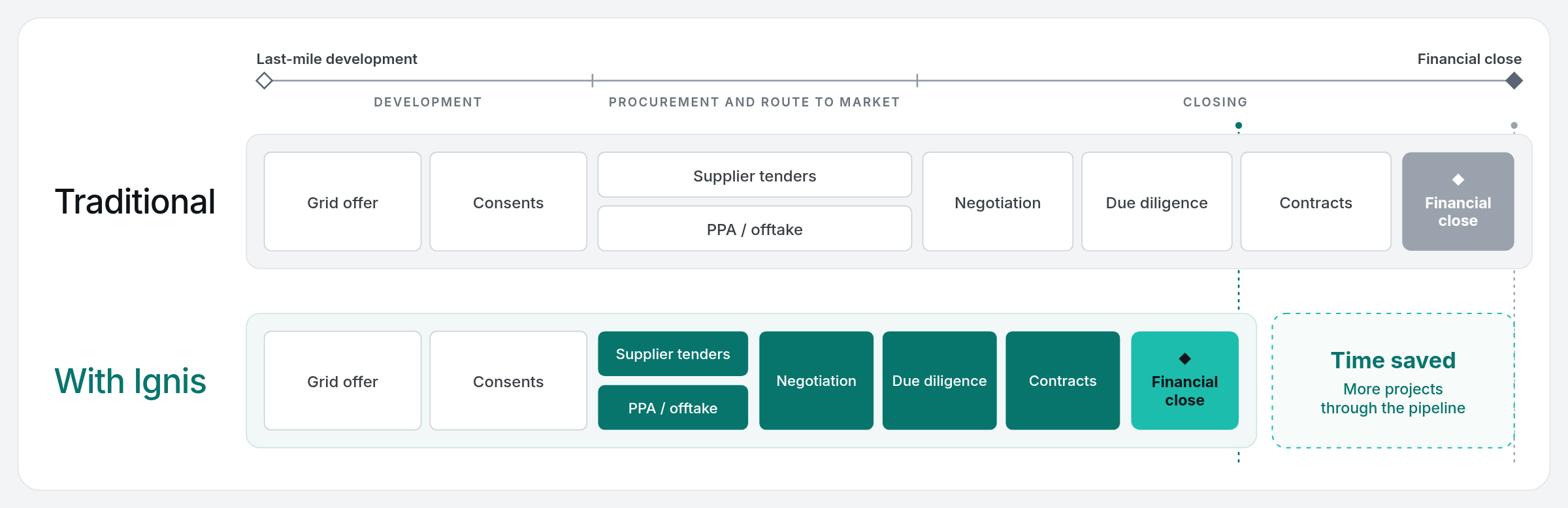
More projects throughto financial close.

Ignis improves the commercial flow from last-mile development to financial close for onshore developers and offshore wind. One governed system, on your data, that gets sharper with every project.

What does Ignis change between the grid offer and close?

The same commercial path shows up on every live project: grid offer, consents, supplier tenders, PPA or offtake, route to market, negotiation, due diligence and contracts. Ignis keeps that path in one client-owned system so the team spends its time on the decision, not on rebuilding the file.

Your people still set price, risk and the commitment. Agents take the repeatable work. Nothing here is a demo sitting beside the business. It runs on the evidence you already use, and each project leaves a better record for the next one.

Who is the system built for?

Onshore developers

For solar, onshore wind, battery storage and long-duration storage. Move more projects from grid offer to financial close with one governed commercial system.

  • Grid offer and consent packs that stay consistent as the project changes
  • Supplier tenders with a single trail from question to award
  • PPA, offtake and route-to-market terms tied back to the bid
  • Negotiation, due diligence and contracts ready for close
Offshore wind developers

For fixed and floating offshore wind. Win tenders on evidence and carry the bid through to contracts and close.

  • Tender evidence that stays traceable from the bid to the contract
  • Supplier packages for foundations, turbines, cables and installation
  • Route-to-market and offtake positions held against the same numbers
  • Due diligence and contract issues visible before financial close

What are the five layers?

The system is not a new platform to buy. It is these five layers, set up on the client's own data and governed by the client.

  1. Process

    How each bid moves from gate to gate, including the handoffs your team already relies on.

  2. Context

    Market, policy and portfolio knowledge, held where the people making the call can see it.

  3. Data

    One trusted set of numbers, so the bid, the tender and the close file stop disagreeing.

  4. Governance

    Approvals, controls and an audit trail proportionate to the commitment being signed.

  5. Workflows

    Repeatable work run by agents, with a named person still accountable for the decision.

The Sprint covers gap review, mapping and design. Pilot and embedding follow.

    1. Gap review

      Start with a live commercial pressure.

    2. Map

      How decisions move today.

    3. Design

      A useful capability, not a demo.

  1. Pilot

    Tested on a live opportunity.

  2. Embed and improve

    Your team keeps the learning.

Commercial gates from grid offer to financial close, compared for a conventional path and a path with Ignis

Questions before you start

What does Ignis improve?

Ignis improves the commercial flow across grid offer, consents, supplier tenders, PPA and offtake, route to market, negotiation, due diligence and contracts. Onshore covers solar, onshore wind, BESS and long-duration storage. Offshore wind covers fixed and floating.

How does the work differ for onshore developers and offshore wind?

Onshore work runs from grid offer to financial close for solar, onshore wind, BESS and long-duration storage. Offshore wind, fixed and floating, is won on tender evidence and then carried through supplier packages, offtake and contracts to close. Ignis uses the same five layers for both, set to the project in front of you.

Who owns the system and the data?

You do. Ignis is set up on your evidence, under your approvals, and the record stays in your control. The data is the files, models and decisions you already use, not a copy held by Ignis. Each project leaves a better record for the next one.

Do we have to replace our tools?

No. Ignis uses the files, models and decisions you already have. A new platform is a later choice, made only if the live work shows it is needed.

How does governance and approval work with AI agents?

Agents prepare the repeatable work: assembling evidence, drafting and cross-checking numbers. A named person still approves price, risk and anything that commits the company, and that approval stays on the record. Ignis does not let an agent sign a bid or a contract.

Which numbers have to agree before financial close?

The bid, the model, the offtake or route-to-market position and the close file have to describe the same project. Ignis holds one trusted set of numbers so capacity, dates and price stop drifting between documents. Conflicts are flagged before a named person resolves them.

What does the client need to bring to the first gate?

A live project and the next decision: the grid offer, the tender, the offtake or the close file. Ignis maps where time goes, which numbers are trusted, and who can approve a change. That is the start of the model, not a workshop on a hypothetical project.

How does the next project reuse the last one?

Support delivery runs the model on the live opportunity, then keeps the learning in the system. The next project starts from that record: the process, the context, the data and the approvals, not from a blank folder. Ignis is built to get sharper with every project you run.

Got a project heading for financial close?

Let’s map where your commercial flow slows down, and what Ignis would change.

Book a call