For years, bid technology has made the same promise: help the team produce the response faster.
That promise is increasingly being delivered.
Current platforms can analyse requirements, retrieve approved content, generate a first draft, route reviews and check consistency. Some now reach further upstream into qualification, prioritisation and expert coordination.
That is useful progress.
But it raises a more interesting question.
What happens when every credible bidder can produce a polished, compliant response faster?
The proposal still matters. And on a complex pursuit, producing it will never be easy in any absolute sense.
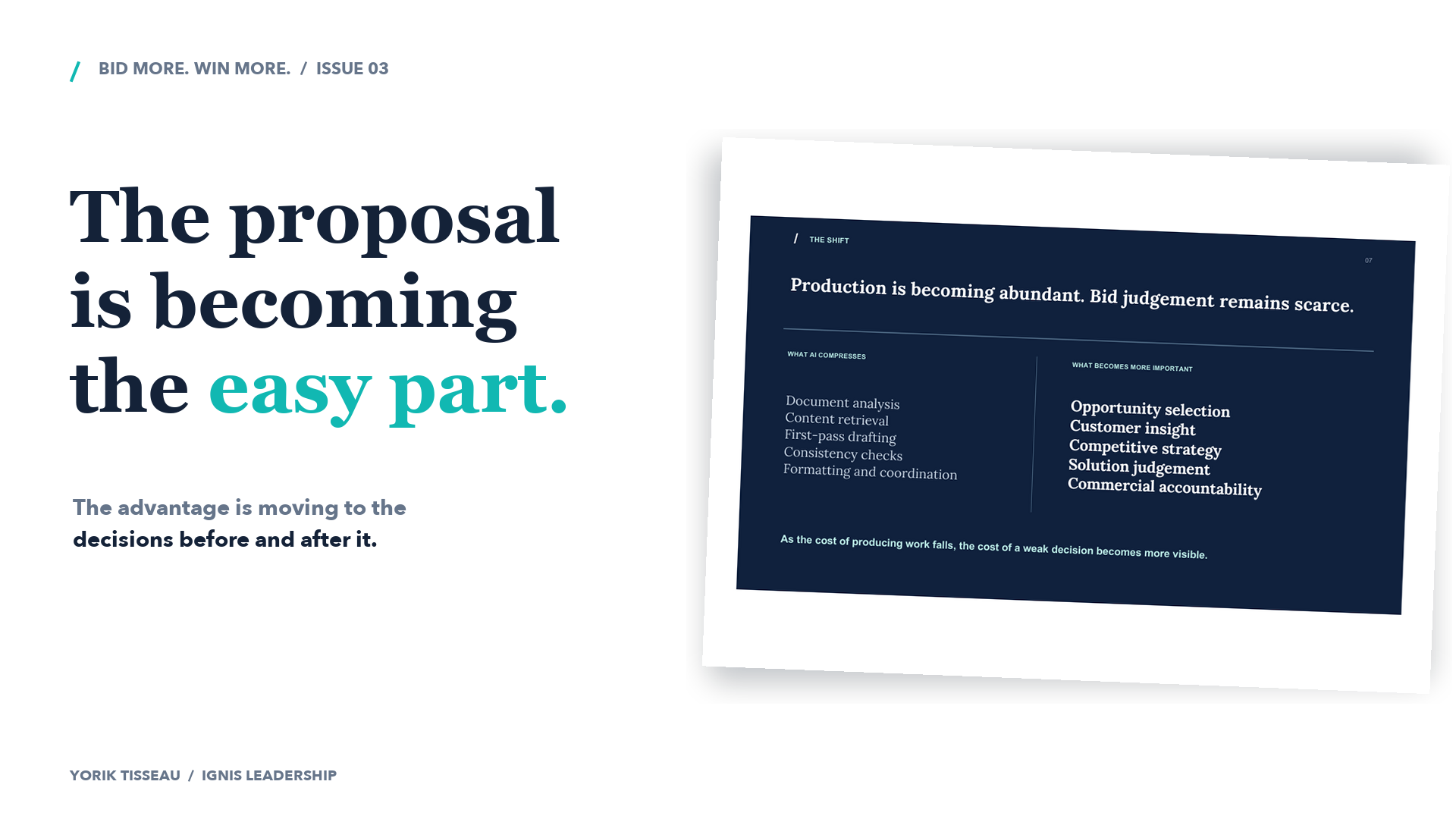
It is simply becoming the easier part of the system.
The harder work sits around it:
- deciding whether the opportunity deserves scarce bid capacity;
- understanding what the customer is really trying to change;
- turning that insight into a differentiated solution;
- challenging weak assumptions before they become commitments;
- finding evidence strong enough to support the claims; and
- knowing which commercial and delivery risks the business is prepared to accept.
In the hardest bids I have led, the writing was rarely where the outcome was lost.
It was lost when an important decision arrived too late.
The customer insight appeared after the strategy had been agreed. A capability gap surfaced halfway through drafting. The evidence behind a major claim was questioned in the final review. A commercial assumption survived because nobody had enough time to challenge it properly.
Faster production does not solve those problems.
It can help the team reach the wrong answer sooner.
The 2026 shift is bigger than proposal automation
The important move is from a document-production process to a governed decision system.
An agentic bid workflow would begin before the tender lands. It could assemble what is already known about the opportunity, the customer, past decisions and available evidence. It could prepare a qualification pack, expose missing information and show the assumptions that need a person to resolve.
As the pursuit develops, it could trace requirements, compare new information with the agreed strategy, challenge unsupported claims and carry unresolved questions into the next review.
The point is not that an agent makes the bid decision.
The point is that the person making it gets better information while there is still time to act.
There are early signs of this pattern in adjacent professional work. In a September 2026 case published by OpenAI, legal platform Legora described an agent that reviewed 41 documents in minutes and found all four deliberately planted errors in a test. The legal expert still retained final judgement.
That is vendor-reported evidence, not independent proof of bid performance. But it illustrates the operating principle: let the system perform the exhaustive preparation; keep consequential judgement with the professional.
The proposal-software market is moving in the same direction. AutogenAI, Loopio and Responsive now describe capabilities beyond simple drafting, including requirement analysis, qualification support, review routing, content governance and expert recommendation.
So the distinction is no longer “proposal software writes; agents think”. That would be too simplistic.
The real distinction is whether the organisation connects those capabilities across the whole lifecycle, with the right context, tests, permissions and human decision rights, or leaves them as isolated features inside the production phase.
More capability needs clearer boundaries
An agent may be allowed to retrieve, compare, prepare, expose and recommend.
It should not silently commit the business to bid, set the price, accept contractual risk or release the submission.
Those boundaries matter because the commercial promise is not merely “fewer drafting hours”.
For the sponsor, the prize is better use of expensive bid capacity, earlier visibility of risk and more disciplined investment in the opportunities that matter.
For the bid professional, the prize is different: less time reconstructing the truth from scattered documents, and more time questioning it.
That is a better future for bid management than becoming a faster content factory.
What we still need to prove
There is not yet enough independent evidence to claim that an end-to-end agentic bid workflow improves win rate or margin.
Anyone making that claim should be able to show the baseline, the human-review burden, the failures and the decisions the system was and was not authorised to make.
That proof will take time.
But the direction is already clear.
When production becomes abundant, producing more is not the advantage.
Making better decisions with the capacity you recover is.

About the author
Yorik Tisseau (MBA) is the founder of Ignis Leadership and a bid strategist with more than 15 years of experience. He has led complex international bids across energy, infrastructure and construction, including offshore wind development at bp and RWE.
Through Ignis Leadership, he helps organisations improve how they pursue and win complex, high-value opportunities. He combines deep bid-management experience with practical AI expertise to strengthen decisions across the lifecycle, from early qualification and strategy through proposal delivery, assurance and learning.